

Site search:
-
What’s new?
Energy for London Tags
Brent Buildings Camden Carbon Emissions CHP Cities Climate Adaptation Community Heating Community Initiatives Croydon Data DECC Decentralised Energy Distribution ECO Energy Costs Energy Efficiency Enfield FIT Fuel Poverty Funding Green Deal Hackney Haringey Housing Islington Lambeth Library Local Authorities Mayor Newham Ofgem Olympics Photovoltaics Planning RE:FIT RE:NEW Renewable Energy Retrofit Southwark Tower Hamlets Transport Waltham Forest Waste WestminsterEnergy Archives:
- February 2021 (1)
- January 2021 (15)
- December 2020 (15)
- November 2020 (9)
- October 2020 (3)
- August 2020 (5)
- July 2020 (3)
- June 2020 (4)
- April 2020 (10)
- March 2020 (5)
- February 2020 (2)
- January 2020 (3)
- October 2019 (1)
- September 2019 (4)
- August 2019 (2)
- July 2019 (1)
- August 2018 (1)
- November 2016 (8)
- October 2016 (8)
- September 2016 (2)
- August 2016 (8)
- July 2016 (14)
- April 2016 (12)
- March 2016 (16)
- February 2016 (8)
- January 2016 (4)
- December 2015 (1)
- November 2015 (1)
- October 2015 (16)
- September 2015 (3)
- June 2015 (1)
- May 2015 (1)
- April 2015 (1)
- March 2015 (1)
- February 2015 (1)
- January 2015 (1)
- December 2014 (18)
- November 2014 (4)
- August 2014 (8)
- July 2014 (7)
- June 2014 (25)
- May 2014 (8)
- April 2014 (4)
- March 2014 (12)
- February 2014 (7)
- January 2014 (13)
- December 2013 (11)
- November 2013 (15)
- October 2013 (15)
- September 2013 (18)
- August 2013 (5)
- July 2013 (20)
- June 2013 (33)
- May 2013 (8)
- April 2013 (16)
- March 2013 (25)
- February 2013 (14)
- January 2013 (20)
- December 2012 (23)
- November 2012 (23)
- October 2012 (25)
- September 2012 (14)
- July 2012 (12)
- June 2012 (43)
- May 2012 (20)
- April 2012 (8)
- March 2012 (40)
- February 2012 (39)
- January 2012 (40)
- December 2011 (22)
- November 2011 (40)
- October 2011 (33)
- September 2011 (48)
- August 2011 (40)
- July 2011 (58)
- June 2011 (41)
- May 2011 (80)
- April 2011 (38)
- March 2011 (33)
- February 2011 (25)
- January 2011 (24)
- December 2010 (3)
- November 2010 (7)
- October 2010 (6)
- September 2010 (7)
- August 2010 (1)
- July 2010 (2)
- June 2010 (4)
- May 2010 (1)
- March 2010 (3)
- February 2010 (3)
- December 2009 (5)
- November 2009 (2)
- October 2009 (3)
- July 2009 (3)
- June 2009 (1)
- April 2009 (1)
- March 2009 (1)
- February 2009 (1)
- January 2009 (1)
- December 2008 (2)
- October 2008 (1)
- September 2008 (1)
- July 2008 (1)
- March 2008 (2)
- January 2008 (2)
- October 2007 (1)
- September 2007 (3)
- July 2007 (1)
- March 2007 (1)
- February 2007 (3)
- November 2006 (3)
- August 2006 (1)
- February 2006 (1)
- May 2005 (1)
- February 2004 (1)
Tag Archives: Carbon Emissions
Under-reporting of greenhouse gas emissions in US cities
2 February 2021: Paper published in Nature Communications which reports that “Cities dominate greenhouse gas emissions. Many have generated self-reported emission inventories, but their value to emissions mitigation depends on their accuracy, which remains untested. Here, we compare self-reported inventories from 48 US cities to independent estimates from the Vulcan carbon dioxide emissions data product, which is consistent with atmospheric measurements. We found that cities under-report their own greenhouse gas emissions, on average, by 18.3% (range: −145.5% to +63.5%) – a difference which if extrapolated to all U.S. cities, exceeds California’s total emissions by 23.5%.” Access the full paper here. The research has attracted a lot of reporting – Reuters, Bloomberg, Science Daily, New York Times, and Wired.
Over the past decade, focus has (rightly) grown on cities and their contribution to national greenhouse gas emissions and – more importantly – the opportunities that cities have to reduce these emissions. Alongside this there has been increasing work undertaken on measuring urban emissions – most notably by C40 Cities. This new research is a further contribution to this subject and highlights the challenge policy makers and others have in measuring emissions at the local level in the complex environment of a city.
Posted in Library
Tagged Carbon Emissions, Cities
Comments Off on Under-reporting of greenhouse gas emissions in US cities
Top UK court overturns block on Heathrow’s third runway
16 December 2020: The Guardian reports that “The supreme court has overturned a February judgment that a third runway at Heathrow airport was illegal. It means the project can now seek planning permission, but the ultimate completion of the runway remains uncertain.
“The supreme court ruling marks the latest twist in years of legal and political wrangling over the climate impact and economic benefits of expanding the airport. The decision in February was seen as historic by environmental campaigners, as it was the first significant ruling in the world to be based on the Paris climate agreement, and related cases were subsequently brought against plans to build more roads and gas-fired power plants in the UK.”
““I still don’t think the third runway is going to happen,” said Tim Crosland, a lawyer at Plan B, which brought the legal case against Heathrow. “The really damaging thing [about the supreme court ruling] is the precedent for the other cases.” The Supreme Court ruling can be seen here. The Mayor responded to today’s ruling stating: ““I am disappointed with the court’s decision today to allow Heathrow Airport a third runway which will have a damaging impact on air quality, noise and London’s ability to achieve net-zero carbon by 2030.“
Posted in News
Tagged Carbon Emissions, Heathrow
Comments Off on Top UK court overturns block on Heathrow’s third runway
City of London Wants to Clean Up the World
20 November 2020: With reference to the Prime Minister’s 10 Point Plan announcement earlier this week – which included a goal to make the “City of London the global centre of green finance” a Bloomberg Opinion piece on how Britain is aiming to be a hub for carbon credit and green derivatives trading. “London… has a history in cutting-edge finance, a deep talent pool and a strong lead in the trillion-dollar swaps market. It’s a logical place to base the trading of carbon credits, and the derivative-like contracts that companies’ would want to tailor for their individual needs, were the worldwide carbon credit market to take off.” Read the full article here.
Unfortunately, it’s far from certain that it will.
Posted in News
Tagged Carbon Emissions, City of London, Green Finance
Comments Off on City of London Wants to Clean Up the World
Merton Net Zero Study
June 2020: Merton Council have commissioned a study to better understand the borough’s existing greenhouse gas impact and decarbonisation pathways to achieve its net zero carbon target. The report sets out “Merton Council declared a climate emergency in July 2019 and set carbon reduction targets to decarbonise the Council by 2030 and the borough by 2050. To underpin the development of Merton’s Climate Strategy & Action Plan, Merton Council commissioned a series of products including greenhouse gas (GHG) inventories for the borough and council, decarbonisation pathways to reach the targets, and means to track progress towards the targets.” Read the full report here.
Posted in News
Tagged Carbon Emissions, climate emergency, Merton
Comments Off on Merton Net Zero Study
Nearly half of UK’s carbon footprint down to emissions from abroad
16 April 2020: Further research around the issue of greenhouse emissions associated with goods and services we use – something the GLA has recently looked into. A WWF study report’s that nearly half of the UK’s carbon footprint comes from emissions released overseas to satisfy UK-based consumption. Carbon Footprint: Exploring the UK’s contribution to climate change, highlights the importance of addressing carbon intensive imports such as animal feed and fossil fuels, which fuel our cars and heat our homes Download there study here.
Posted in Library
Tagged Carbon Emissions
Comments Off on Nearly half of UK’s carbon footprint down to emissions from abroad
London’s wider greenhouse gas impacts
March 2020: A new research paper published by the Greater London Authority (GLA) considering an issue often raised – which is what is the total impact of London’s greenhouse gas emissions, taking into account the goods and services that Londoners use.
The paper ‘Consumption based Greenhouse Gas Emissions for London
(2001 – 2016)‘ undertaken by the University of Leeds, sets out that it was commissioned to understand “the total greenhouse gas impact Londoners have, including those emissions that take place outside London’s physical boundaries, in order to tackle the climate emergency.” The methodology employed in the report allows for “emissions that occur due to the consumption activities of London residents, including all the emissions associated with the production of goods and services throughout their complete supply chain…” So what difference does it make to London’s GHG emissions when taking into account a combustion based route?
Posted in Library, News
Tagged Carbon Emissions
Comments Off on London’s wider greenhouse gas impacts
TfL carbon fine
November 2016: The Environment Agency has released data of (CRC) Energy Efficiency Scheme civil penalties – a list of organisations which have failed to comply with the Carbon Reduction Commitment and have subsequently been fined – where, interestingly TfL have been fined the maximum amount:
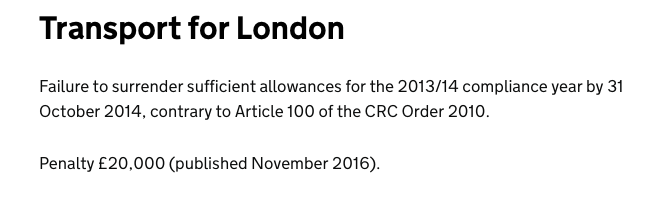
A TfL Audit and Assurance Committee paper from June 2015 reported that the CRC “scheme requires participants to measure and report on their energy consumption and to buy allowances from the Environment Agency for the amount of CO2 emissions associated with their energy consumption. London Underground had submitted the appropriate report by the July 2014 deadline but, by administrative oversight, had not taken the further step of ordering and purchasing the requisite allowances. London Underground remedied the matter and complied with the notice within the timescales required. To avoid a recurrence, London Underground’s administrative procedures have been reviewed and improved.“
Energy and Climate Questions to the Mayor
June 2016: Positive to see the focus on energy and climate issues by a number of London Assembly members at the first question time of the new Mayor, Sadiq Khan. This month’s questions included the following issues:
the quantity of electricity supplied to TfL through the Mayor’s Licence Lite operation and few other questions on Licence Lite (here and here); supporting the growth of London community energy schemes; the London Energy Strategy; committing to London’s 25 per cent decentralised energy target; the 2020 nearly zero energy buildings target; the publication of the annual update to the GLA Energy and Climate Change Mitigation Strategy; London Energy Plan supporting studies; supporting the growth of district heating projects; support for London’s 2025 60 per cent carbon reduction target; the future of the RE:NEW and RE:FIT building retrofit programmes; the number of domestic energy efficiency retrofits supported by RE:NEW since January 2015; numbers on the GLA’s boiler scrappage list; ring fencing London’s Zero Carbon Homes offset fund; the number of zero carbon homes that could be built by 2020; zero carbon buildings planning requirements will come into force in 2019; how much money could be raised through the Zero Carbon Homes offset fund; interim targets to the Mayor’s manifesto commitment for London to be a zero carbon city by 2050; climate change and water vapour; how the Mayor will support London’s low carbon economy; emissions from river traffic (and another); zero emission cabs and PHVs abd if CO2 is a pollutant – and finally:
whether the Mayor understands “that further increases in carbon dioxide levels will not significantly increase average global temperatures due to near saturation absorption by CO2 in the 13 – 17 µm band of the infra-red spectrum”.
Previous months questions to the Mayor can be found here.
New Ideas for London
April 2016:  A further contribution of potential actions for an incoming Mayor – this time by Arup – in report just published ‘New Ideas in London‘. In the report Arup identify “five areas that the new Mayor should focus on during their first term in office.” Amongst these are a couple considering energy and climate issues – a summary of which follow below:
Driving down corporate carbon emissions
- The Mayor has the authority to help adjust London’s procurement protocols to include corporate carbon performance.
- The new Mayor could immediately commission a consultation led by the GLA’s Head of Legal and Procurement to investigate legislative options.
Electric bus battery switch scheme
- Could London work with existing suppliers to design buses that allow their batteries to be switched out quickly and smoothly without disrupting operations? This could take place at optimum points on the network and could ensure that operations are not penalised by the time it takes to charge bus batteries.
Other areas of interest include ‘A London Blue Grid’ and ‘Walking in a Green London’.
Posted in Library, News
Tagged Carbon Emissions, Climate Adaptation, Electric Vehicles
Leave a comment
The Pope’s Encyclical on Climate Change & Cities
19 June 2015: It’s unlikely I’m going to get through the full 180 pages of the Pope’s Encyclical on Climate Change (by the way – if you’re looking for the contents page – it’s at the end of the document), but I did want to see if there was anything there on cities – and was pleased to see that there is specific consideration on how the quality of life of urban dwellers is impacted on by the state of the environment around them.
Selected below are parts of the Encyclical that touch upon the challenges placed upon cities due to environmental stresses and increasing climate change. Much of it is quite general, and much of it is probably more targeted at those growing mega-cities of the South – but the points equally resonate to pockets of deprivation in London as well as in many other developed cities.
“44. Nowadays, for example, we are conscious of the disproportionate and unruly growth of many cities, which have become unhealthy to live in, not only because of pollution caused by toxic emissions but also as a result of urban chaos, poor transportation, and visual pollution and noise. Many cities are huge, inefficient structures, excessively wasteful of energy and water. Neighbourhoods, even those recently built, are congested, chaotic and lacking in sufficient green space. We were not meant to be inundated by cement, asphalt, glass and metal, and deprived of physical contact with nature.
Energy & Climate Questions to the Mayor
January 2015: This month the Mayor has been asked questions in relation to:
Fuel Povery and Children; Meetings of the Mayor’s London Green Infrastructure Task Force; Membership of the Mayor’s London Green Infrastructure Task Force; London Plan policies encouraging development of solar farms; consideration of carbon emissions in policy decision making
Invitation to attend the European Capital Cities meeting ahead of the Paris 2015 IPCC summit; Progress made in 2014 to delivering the London Climate Change Adaptation Strategy; Measuring CO2 emissions across the GLA Group; An update on the GLA group’s Carbon Reduction Commitment (CRC) reports; the Mayor’s concern over increasing signs of climate change; GLA Economics analysis on energy
Communication to the Treasury over tax incentives for community energy projects; TfL’s hedging policy on energy prices; Misleading information on shale gas; Reallocation of RE:NEW funds to RE:FIT programme; Havering Solar Farm planning application; New powers to Ofgem; RE:NEW programme underspend; An update on RE:NEW programme projections; Research commissioned by the GLA’s Environment Team
Previous months questions to the Mayor can be found here.
Posted in Energy Efficiency, News, Renewable Energy
Tagged Carbon Emissions, Climate Adaptation, Community Initiatives, Photovoltaics, RE:FIT, RE:NEW
Leave a comment
Energy and Climate Questions to the Mayor
July 2014: This month the Mayor has been asked questions in relation to:
Mayoral involvement with the Local Government Climate Roadmap; organisations operating at the London Sustainable Industries Park; potential for the London Pension Fund Authority (LPFA) to invest in low carbon London projects; whether Energy Performance Certificate or Green Deal assessments will be provided for homes that go through the RE:NEW programme; monitoring high energy consuming buildings in London; reductions in forecasted projections of CO2 savings in Mayor’s energy supply programme; Transport for London’s (TfL) Energy Strategy; the Mayor’s Memorandum of Understanding (MoU) with energy suppliers; visit by Mayor’s energy advisor to Camden’s biomethane refuelling station; correspondence with DCLG on the Mayor being able to set London specific energy efficiency targets in planning rules for new development; meetings with DECC over encouraging the use of solar PV on GLA land and building; new district heating network using heat from Greenwich Power Station; the low take up of ECO energy efficiency programme in London; connecting Whitehall District Heating Scheme to Pimlico District Heating Undertaking; the Mayor’s response to a recent London Solar Energy report by Green Party London Assembly member Jenny Jones; future TfL electricity costs; whether the Mayor responded to the Government’s recent solar PV consultation; concerns over government changes to the ECO as raised by the Mayor; funding for the next round of the RE:NEW programme; energy efficiency requirements in the private rented sector; monies received by the Green Bus Fund; work being undertaken to assess the economic impact to London as a result of climate change; attendance at the World Mayors Summit of Climate Change; planning offset funds; contract awarded for management of the RE:NEW programme; and if the Mayor’s High Level Electricity Working Group has considered solar PV.
Previous months questions to the Mayor can be found here.